
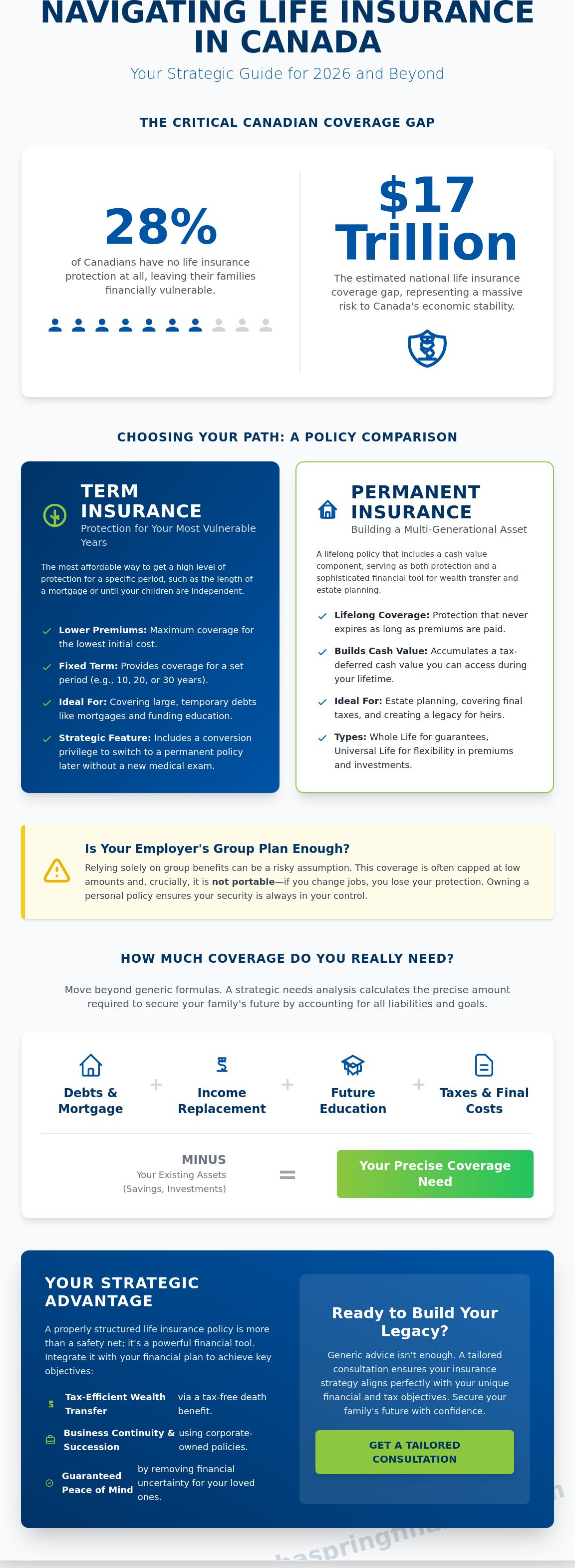
Did you know that nearly 28% of Canadians currently carry no protection at all, contributing to a staggering $17 trillion national coverage gap? It's a sobering figure that highlights how many families remain vulnerable to sudden financial shifts. You likely recognize that life insurance Canada is a cornerstone of a responsible financial plan, yet the sheer volume of policy jargon and conflicting advice can feel overwhelming. It's natural to worry about whether you're paying for too much coverage or, perhaps more dangerously, leaving your loved ones with too little.
We understand that you want more than just a policy; you want a strategic asset that integrates with your tax planning and long-term goals. This guide provides the clarity you need to navigate the 2026 landscape with confidence. We'll examine the critical differences between temporary and lifelong coverage, explore how to use insurance as a tax-efficient wealth transfer tool, and help you secure a legacy that stands the test of time.
Key Takeaways
- Recognize how the 2026 economic landscape necessitates a shift from basic coverage toward treating insurance as a strategic financial asset.
- Distinguish between the flexibility of term policies and the guaranteed cash value of permanent coverage to find the right fit for your family's future.
- Move beyond generic formulas by learning to calculate a precise life insurance Canada benefit that accounts for your specific debts, taxes, and estate costs.
- Uncover tax-efficient methods to transfer wealth and protect business continuity using corporate-owned insurance structures and tax-exempt death benefits.
- Understand the value of a tailored consultation to ensure your insurance strategy integrates seamlessly with your broader financial and tax objectives.
The Essential Role of Life Insurance in the Canadian Financial Landscape
At its core, life insurance is a binding contract that provides a tax-free lump sum to your beneficiaries upon your passing. It's a tool designed to convert potential financial chaos into a structured guarantee. While many view it as a simple death benefit, a comprehensive overview of life insurance reveals its dual nature as both a shield for your family and a strategic asset for your estate. In a country where household debt reached 180.7% of disposable income recently, the role of life insurance Canada has shifted from a luxury to a fundamental necessity for long-term financial survival.
The economic climate of 2026 brings unique challenges. With rising living costs and complex tax brackets, the distinction between protection and wealth preservation is vital. Protection ensures your mortgage is paid and your children's education is funded. Wealth preservation, however, focuses on optimizing how you transfer assets to the next generation without losing a significant portion to the Canada Revenue Agency. By integrating insurance into your broader portfolio, you create a buffer that protects your other investments from being liquidated during a crisis.
Why Relying Solely on Group Benefits May Be Risky
Many Canadians feel secure because they have coverage through their employer. This is often a precarious assumption. Group benefits are typically capped at low multiples of your salary and, more importantly, they aren't portable. If you change careers or face a health-related retirement, that coverage often vanishes exactly when you need it most. Owning your own policy ensures you remain in control of your security regardless of your employment status. It provides a permanent foundation that employer plans simply cannot match.
The Peace of Mind Factor: Removing Uncertainty
Financial planning is as much about psychology as it is about numbers. For a primary breadwinner, the weight of "what if" can be a constant source of stress. A well-structured policy removes this burden. It allows you to focus on growth today because you've already secured tomorrow. Knowing your family can stay in their home and maintain their lifestyle provides a sense of calm that no other financial product can replicate. You aren't just buying a policy; you're investing in the quiet confidence that your legacy is protected. This stability is the cornerstone of a balanced financial life.
Comparing Term and Permanent Life Insurance: Choosing Your Path
Selecting the right type of life insurance Canada requires a careful balance between your current cash flow and your long-term estate goals. It isn't a binary choice between one or the other. Instead, it's about alignment with your specific life stage. The Financial Consumer Agency of Canada guide to life insurance provides a foundational look at how these contracts function. Generally, you'll choose between temporary protection for immediate risks and permanent solutions that build equity over time. Your premiums will depend on several factors, including your age, health history, and lifestyle choices like smoking or high-risk hobbies.
Term Insurance: Protecting Your Most Vulnerable Years
Term insurance is the most straightforward and affordable way to secure a high level of protection. It's designed to cover specific windows of financial vulnerability, such as the duration of a mortgage or the years your children are in university. These policies offer a tax-free death benefit if you pass away during the set term. A critical advantage often overlooked by basic online tools is the conversion privilege. This feature allows you to transition your term policy into a permanent one later without undergoing a new medical exam. It's a strategic safety net that protects your future insurability even if your health changes.
Whole and Universal Life: Building a Multi-Generational Asset
Permanent insurance, including Whole and Universal Life, serves as a sophisticated multi-generational asset. Whole life offers a sense of absolute certainty with guaranteed premiums and a cash value component that grows over time. Universal life provides more flexibility, allowing you to adjust your premiums or investment mix as your financial goals evolve. These policies are essential for estate planning in Canada. They provide the necessary liquidity to cover terminal tax liabilities on secondary properties or family businesses, ensuring your heirs don't have to sell assets to pay the CRA.
Many Canadians find the most success with a "laddered" approach. This involves maintaining a permanent policy for foundational needs, like funeral costs and taxes, while layering term insurance to cover peak debt years. Determining the precise mix for your family requires a deep dive into your numbers. Taking a tailored approach to your financial analysis can help you identify exactly where your protection ends and your wealth optimization begins. This methodical strategy ensures you aren't over-insured during your later years or under-insured during your most critical ones.
Determining Your Coverage: A Strategic Needs Analysis
Many people rely on a simple rule of thumb, such as purchasing ten times their annual salary. While this provides a rough estimate, it often fails to account for the unique complexities of your financial life. A truly strategic analysis of life insurance Canada requires a deeper look at both immediate liabilities and long-term aspirations. It's about ensuring your family doesn't just survive, but maintains the standard of living you've worked so hard to build. You must consider immediate cash needs for funeral expenses and legal fees, which can quickly deplete a family's liquid savings during an already stressful time.
Inflation is another silent factor that many overlook. A payout that seems substantial today may lose significant purchasing power over the next twenty or thirty years. Your planning should account for the rising cost of living to ensure the benefit remains meaningful when it's eventually needed. This foresight is what separates a basic policy from a true financial legacy.
The DIME Method for Canadian Families
The DIME method offers a methodical way to break down your requirements into four manageable categories. This structured approach helps remove the guesswork from your planning:
- Debt: List all personal loans, credit card balances, and lines of credit that should be cleared to leave your family with a clean slate.
- Income: Determine how many years of your salary your family needs to replace to remain financially stable.
- Mortgage: Target the remaining balance of your primary residence to ensure your loved ones can stay in their home without the burden of monthly payments.
- Education: Calculate the future costs of post-secondary tuition and intended contributions to your children's RESPs.
Factoring in Existing Assets and Savings
Your insurance needs don't exist in a vacuum. Current balances in a TFSA or RRSP act as a partial buffer, potentially reducing the total death benefit you need to purchase. However, it's vital to recognize the tax implications at play. In Canada, death triggers a "deemed disposition" of certain assets, which can lead to significant capital gains taxes. If your estate consists of a family cottage or a non-registered investment portfolio, those tax bills can be substantial. A well-tailored policy provides the liquidity to settle these debts with the CRA. This allows your heirs to inherit the full value of your legacy rather than being forced to sell assets to cover the bill. As your net worth grows and your debts decrease, your coverage should be adjusted to reflect your evolving financial reality.
Tax Efficiency and Corporate Strategies for Business Owners
For Canadian entrepreneurs and incorporated professionals, life insurance is far more than a simple safety net. It functions as a sophisticated tax-management tool that protects the value of your hard work. In Canada, the death benefit from a life insurance policy is generally received tax-free. This creates a unique opportunity to move wealth out of a corporation and into the hands of heirs with minimal friction. While basic plans focus on personal protection, a strategic approach to life insurance Canada integrates your policy with your corporate structure to maximize every dollar earned.
One of the most powerful mechanisms available to business owners is the Capital Dividend Account (CDA). When a corporation owns a policy and receives the death benefit, the proceeds (minus the policy's adjusted cost base) are credited to this account. This allows the corporation to pay out tax-free dividends to shareholders. Without this strategy, extracting similar amounts from a company could trigger significant personal income tax, especially for those in the 33% federal tax bracket for income over $258,482. Additionally, using insurance to fund buy-sell agreements ensures that surviving partners have the liquidity to purchase a deceased owner's shares. This prevents business disruption and provides the departing family with immediate, fair value.
Corporate-Owned Life Insurance for Professionals
Incorporated doctors, lawyers, and consultants often face high personal tax rates. By holding a life insurance policy within their corporation, they can pay premiums using corporate dollars. These dollars have only been subjected to the lower corporate tax rate, rather than the much higher personal income tax rate. This effectively reduces the "pre-tax" cost of the insurance. Beyond tax sheltering, these policies protect the firm against the loss of a key person. It provides the capital necessary to recruit a replacement or cover lost revenue during a transition period.
Estate Planning: Minimizing the CRA’s Share
The final tax bill for a Canadian estate can be substantial, particularly when it includes a family business or secondary properties. Life insurance provides the liquidity needed to settle these "terminal" taxes without forcing your heirs to sell family assets at a discount. It also serves as an excellent tool for estate equalization. If one child is set to inherit the family business, life insurance can provide a comparable inheritance for other siblings. For those with philanthropic goals, naming a charity as a beneficiary can also result in significant tax credits for the final estate return. To see how these strategies fit your specific situation, you can consult with a corporate tax specialist to build a bespoke plan.
Partnering with a Wise Guide for Your Insurance Journey
An online calculator provides a numerical estimate, but it lacks the nuance of a lived life. It cannot account for your specific family dynamics, your corporate structure, or your long-term philanthropic goals. Securing life insurance Canada involves more than just selecting a policy; it requires a deep understanding of how that contract interacts with your existing assets and future tax liabilities. A "vending machine" approach to insurance might offer speed, but it often sacrifices the strategic depth necessary to protect a complex estate. You deserve a plan that reflects the meticulous care you've put into building your wealth.
A truly effective strategy is never static. Your financial life is in constant motion, influenced by business growth, family milestones, and shifts in Canadian tax legislation. An advisor who understands the intersection of insurance and corporate tax provides a level of foresight that a standalone policy cannot offer. They ensure your coverage remains aligned with your reality, preventing the common pitfalls of being under-insured during periods of growth or over-paying for redundant protection as your net worth increases. Regular policy reviews aren't just a formality; they're an essential practice to maintain the integrity of your financial legacy.
The Alphaspring Financial Inc. Advantage: A Holistic Perspective
At Alphaspring Financial Inc., we view ourselves as your wise guide through the complexities of wealth management. We don't just sell policies; we integrate protection into your total financial forecast. By combining insurance expertise with professional accounting and business plan development, we create a unified strategy that serves both your family and your firm. Our commitment is to provide a sense of stability and calm. We handle the meticulous details of your planning so you can focus on the milestones that matter most. This holistic perspective ensures that every decision supports your long-term vision of success and security.
Next Steps: Securing Your Future Today
The journey toward financial certainty begins with a clear, focused conversation. During a professional consultation, we'll conduct a tailored needs analysis that looks far beyond simple income multiples. We'll examine your debt obligations, corporate structure, and specific family goals to build a bespoke strategy that fits your life. To prepare for this session, it's helpful to gather information regarding your current assets, liabilities, and any existing group benefits you may have. Taking this step today removes the weight of uncertainty and replaces it with a clear, actionable path forward. When you are ready to move from planning to protection, we invite you to Book a consultation with our seasoned experts at Alphaspring Financial Inc. to begin your journey.
Building a Foundation for Lasting Financial Certainty
Securing your family's future requires more than just a policy; it demands a comprehensive strategy that evolves alongside your success. We have explored how life insurance Canada serves as a cornerstone for both immediate protection and long-term wealth preservation. Whether you are a business owner optimizing corporate tax through a Capital Dividend Account or a parent ensuring your children's education is funded, the right plan removes the weight of uncertainty. You've worked hard to build your legacy. Protecting it requires a partner who understands the intricate details of your financial life.
Alphaspring Financial has provided professional guidance founded in 2017. Our team acts as seasoned experts in Canadian wealth management, integrating tax advisory with insurance solutions to create a seamless experience. We believe that meticulous planning today leads to profound peace of mind tomorrow. You don't have to navigate these complex decisions alone. Every detail of your financial security deserves the care and foresight of a trusted consultant.
Secure your family’s legacy with a tailored life insurance strategy from Alphaspring Financial. Take the first step toward a more stable and confident financial future today.
Frequently Asked Questions
Is life insurance taxable for my beneficiaries in Canada?
No, the death benefit paid to a named beneficiary is generally received tax-free in Canada. It isn't considered taxable income, meaning your loved ones receive the full amount intended for their protection. This tax-exempt status applies to both term and permanent policies. It makes life insurance one of the most efficient ways to transfer wealth to the next generation.
How much life insurance do I actually need to protect my family?
Your coverage should be based on a personalized analysis of your specific financial obligations rather than a generic formula. You should calculate the total of your outstanding debts, the income required to support your family's lifestyle, and future costs like university tuition. Subtracting your liquid assets from this total helps identify the precise gap that your policy needs to bridge.
Can I change my life insurance policy from term to permanent later?
Yes, most Canadian term policies include a conversion privilege that allows you to switch to permanent coverage. This feature is vital because it lets you transition your policy without undergoing a new medical exam. It protects your ability to get lifelong coverage even if your health changes. You typically just need to exercise this option before a specific age or expiry date.
What is the difference between whole life and universal life insurance?
Whole life insurance offers guaranteed premiums and a predictable cash value growth, while universal life provides more flexibility. With whole life, your costs remain stable for your entire life. Universal life allows you to adjust your premium payments and choose how the cash value is invested. Both types provide lifelong protection, but the right choice depends on your desire for certainty versus control.
Do I need life insurance if I already have group benefits at work?
Yes, because group benefits are often insufficient and rarely portable if you change careers. Most workplace plans only provide coverage equal to one or two times your annual salary. This amount is usually not enough to clear a mortgage or fund a long-term retirement. Owning a private policy ensures you remain in control of your family's security regardless of your employment status.
How does corporate-owned life insurance benefit my business?
Corporate-owned insurance protects business continuity and provides a tax-efficient way to manage company surplus. It can fund buy-sell agreements, ensuring that surviving partners have the liquidity to purchase a deceased owner's shares. Additionally, death benefits can often flow out of the corporation tax-free through the Capital Dividend Account. This strategy prevents the loss of value that typically occurs when extracting corporate funds.
What factors affect my life insurance premiums in Canada?
Your age, health history, and lifestyle choices are the primary factors that determine your monthly costs. Insurance companies evaluate your medical records and habits, such as smoking or participating in high-risk hobbies. Securing life insurance Canada while you're young and healthy is often the most cost-effective strategy. It allows you to lock in lower rates before age-related health issues begin to influence your insurability.
Can I use life insurance as a tool for retirement planning?
Yes, permanent life insurance can act as a supplemental asset to diversify your retirement income. These policies build cash value over time that grows on a tax-deferred basis. You can access this equity through policy loans or withdrawals to supplement your lifestyle during your later years. It provides a stable, conservative component to a retirement plan that already includes traditional tools like RRSPs and TFSAs.