

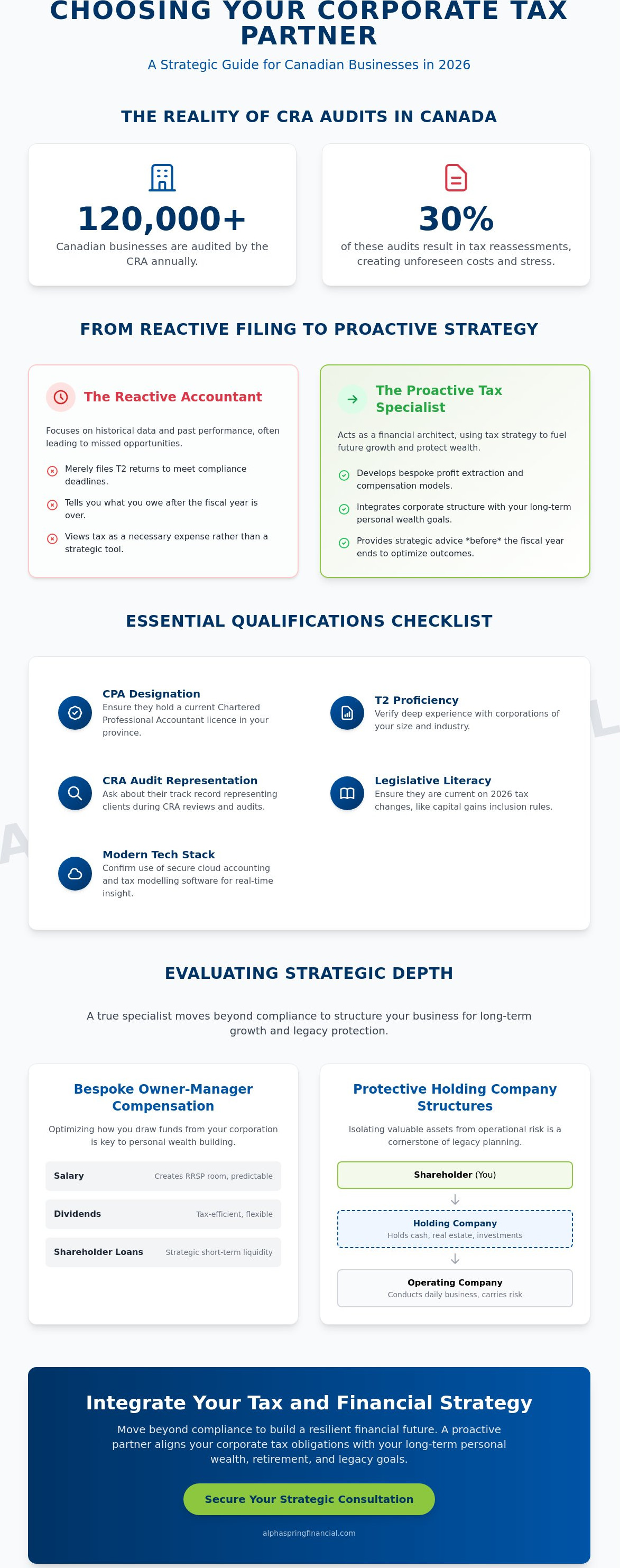
The Canada Revenue Agency audits over 120,000 businesses annually, and nearly 30% of those cases result in tax reassessments. This reality often leaves Canadian business owners feeling like they're overpaying or vulnerable to sudden compliance risks. If you feel your current approach is too reactive, choosing a corporate tax specialist who understands the 2026 landscape is the most effective way to secure your company's future. You deserve a partner who does more than just file returns; you need someone who integrates your corporate structure with your long-term personal wealth goals.
At Alphaspring Financial Inc., we understand the desire for a stable, tax-efficient structure that offers genuine peace of mind. This article provides a definitive checklist to help you master the selection process and find a tax partner who protects your revenue while fueling strategic growth. We'll explore how to verify professional qualifications and ensure your specialist can manage the complex and diverse tax regulations across Canada. This guide outlines the path toward finding a wise consultant who handles every detail of your corporate tax and financial analysis with meticulous care.
What You Will Learn:
Distinguish between a general accountant and a dedicated specialist to move from reactive filing to a proactive growth strategy.
Confirm the CPA designation and T2 return expertise as the essential baseline when choosing a corporate tax specialist for your business.
Evaluate strategic depth by exploring bespoke owner-manager compensation models and holding company structures that protect your legacy.
Apply a structured interview framework to identify potential red flags. Frequent, clear communication is vital for long-term success.
Align your corporate tax obligations with long-term foresight through an integrated advisory approach that includes retirement and insurance planning.
Beyond Compliance: Why Your Choice of Corporate Tax Specialist Matters in 2026
Filing a T2 return is a baseline requirement for any Canadian business, but it's only the beginning of a truly healthy financial strategy. Many entrepreneurs treat tax season as a hurdle to clear rather than a strategic opportunity to protect their earnings. Choosing a corporate tax specialist involves finding a professional who looks beyond the spreadsheet to act as an architect for your firm's future. In 2026, the gap between simple data entry and sophisticated tax modelling has widened, especially as businesses navigate shifting provincial rates and new federal incentives.
A reactive approach to taxation focuses entirely on historical data. You hand over your receipts, and your accountant tells you what you owe for the previous year. This method often leads to frustration when you realize you've overpaid or missed opportunities for profit extraction. A proactive partner works in the present to influence the future. They help you decide how to pay yourself, when to invest in new equipment, and how to structure inter-corporate dividends before the fiscal year ends.
To better understand the strategic value a professional brings to your business, watch this helpful video:
The Cost of the Wrong Choice
The financial impact of a poor selection is often hidden until it's too late. Small errors in Capital Cost Allowance (CCA) claims or missed deductions can result in thousands of dollars in lost cash flow over several years. Perhaps more taxing is the emotional weight of a CRA audit. With over 120,000 businesses audited annually, the stress of a reassessment can be overwhelming. Relying on a professional with a Chartered Professional Accountant (CPA) designation provides a necessary layer of protection. It ensures your filings meet rigorous standards, giving you the confidence to focus on your core operations without the fear of unexpected penalties.
The Evolving Role of the Tax Partner
Modern tax specialists serve as trusted consultants who integrate corporate tax services Canada into your overall growth engine. They utilize financial forecasting to predict tax liabilities based on your specific industry's trajectory. This allows for bespoke profit extraction strategies that align with your personal wealth goals. Instead of a one-size-fits-all solution, they offer a tailored roadmap that considers your family milestones and legacy. By choosing a corporate tax specialist who understands these nuances, you transition from simply staying compliant to building a lasting financial foundation.
The Essential Qualifications Checklist: Verifying Professional Expertise
Choosing a corporate tax specialist requires a methodical approach to ensure your business remains on a stable foundation. You aren't just hiring a data entry clerk; you're selecting a guardian for your company's revenue and a partner in your long-term legacy. Before signing an engagement letter, use this checklist to verify that your prospective partner possesses the technical depth needed for the 2026 fiscal year.
- CPA Designation: Confirm they hold a current Chartered Professional Accountant license in your province.
- T2 Proficiency: Verify their experience with corporations of your specific scale and complexity.
- Audit History: Ask about their track record representing clients during CRA reviews and reassessments.
- Legislative Literacy: Ensure they understand the 2026 capital gains inclusion rules and provincial rate shifts.
- Tech Stack: Confirm they utilize secure cloud accounting and modern tax modelling software for real-time insights.
The CPA Designation and Good Standing
In the Canadian financial landscape, the CPA designation serves as the non-negotiable benchmark for professional ethics and technical skill. It's the first thing you should check when choosing a corporate tax specialist. You can easily verify a firm’s status through provincial CPA directories, such as those in Ontario, British Columbia, or Alberta. This step confirms they are in good standing and subject to rigorous regulatory oversight. Beyond the title, ensure the firm carries professional liability insurance. This protection acts as a safety net for your business, providing an extra layer of security should complex filing errors occur. Following guidance from the Canada Revenue Agency helps you understand your rights and responsibilities when authorizing a representative to act on your behalf.
Specialized Industry Experience
Tax laws aren't applied uniformly across every sector. A medical professional operating through a professional corporation faces vastly different tax hurdles than a construction firm owner managing heavy equipment depreciation. When interviewing a specialist, inquire about their current client portfolio. Do they understand Scientific Research and Experimental Development (SR&ED) tax credits or specific manufacturing incentives? If you operate in Ontario, they must be prepared for the small business tax rate reduction to 2.2% effective July 1, 2026. A specialist who understands these nuances can identify bespoke savings that a generalist might overlook. For those seeking a deeper integration of their business and personal wealth, exploring comprehensive accounting and tax planning can provide the foresight needed for sustainable growth.
Strategic Depth: Evaluating Specialized Knowledge for Corporate Growth
When choosing a corporate tax specialist, you must look for an advisor who treats your business as a living entity rather than a series of static numbers. A true expert understands the delicate balance of owner-manager compensation. They should suggest a mix of salary and dividends that minimizes your personal tax burden while maximizing corporate deductions. This level of foresight is essential for maintaining liquidity and fueling sustainable growth.
Holding companies offer a layer of stability and strategic flexibility. Your specialist should explain how inter-corporate dividends can move profits from an operating company to a holding company tax-free. This strategy shields your surplus from operational risks and prepares your structure for the Lifetime Capital Gains Exemption (LCGE). If your business operates across borders, choosing a corporate tax specialist with international expertise becomes even more critical to avoid double taxation and ensure compliance with global reporting standards.
Tax-Efficient Retirement Vehicles
For many incorporated professionals, an Individual Pension Plan (IPP) provides significantly more contribution room than a standard RRSP. Your specialist should coordinate these retirement vehicles with your broader estate plan. This often involves using life insurance Canada to fund buy-sell agreements or provide the necessary liquidity to cover tax liabilities upon succession. A methodical approach to these details ensures your legacy remains intact for the next generation while protecting your family's financial security.
Advanced Corporate Structuring
Managing family trusts requires a nuanced understanding of TOSI (Tax on Split Income) rules to avoid punitive tax rates. As we navigate the 2026 fiscal year, the updated Capital Gains Inclusion Rate demands precise modelling. You need to know exactly how asset sales will impact your bottom line before you commit to a transaction. Moving from a once-a-year filing mindset to a schedule of quarterly planning meetings allows you to adjust your strategy in real-time. This proactive rhythm removes uncertainty and replaces it with a clear, logical path toward your long-term goals.
The Interview Framework: Key Questions and Red Flags to Recognize
Choosing a corporate tax specialist is as much about the human connection as it is about technical prowess. You need a partner who values your long-term security and understands the unique rhythm of your business. This selection process shouldn't feel like a high-pressure sales meeting; instead, it should feel like a collaborative consultation where your goals are the primary focus. Use this structured framework to interview potential candidates and ensure they align with your vision for growth.
Start by inquiring about their communication style. A proactive specialist doesn't wait for you to call with a problem. They reach out with insights before deadlines approach. When you discuss fees, look for a specialist who explains whether they bill by the hour or provide value-based pricing for specific projects. Transparency is the bedrock of trust. Next, ask for a specific example of how they saved a client tax through strategic planning. This reveals their ability to apply theoretical knowledge to real-world scenarios. Finally, when you are choosing a corporate tax specialist, ask who will actually handle your file. You want to ensure that a senior expert is overseeing the meticulous details rather than delegating everything to an unsupervised junior clerk.
Top 5 Questions to Ask Your Potential Specialist
- "How do you stay updated on CRA changes that affect my specific industry?" This ensures they are tracking relevant shifts, such as the 2026 capital gains inclusion rules.
- "What is your process for identifying missed tax-saving opportunities from prior years?" A thorough review of past filings can often uncover significant recovered revenue.
- "How do you collaborate with my other financial and insurance advisors?" Integration is key for funding buy-sell agreements or managing Individual Pension Plans.
- "What is your average response time during the peak of tax season?" You need to know you won't be ignored when you need them most.
- "Can you walk me through your approach to CRA audit representation?" Understanding their defensive strategy provides essential peace of mind.
Critical Red Flags to Avoid
Be wary of any professional who "guarantees" specific refund amounts before they have even opened your books. The CRA operates on facts and legislation, not promises. Another significant red flag is a firm that becomes unresponsive during non-tax season months. Your business operates year-round, and your tax strategy should too. Avoid "transactional" firms that show no interest in your long-term business growth goals. If they only care about the current filing and ignore your personal wealth milestones, they aren't the right fit. For a partnership that prioritizes your legacy, book a consultation with our experienced team to discuss a tailored approach for your corporation.
Integrating Tax and Financial Strategy with Alphaspring Financial
Choosing a corporate tax specialist should involve more than just finding someone to check boxes for the CRA. At Alphaspring Financial Inc., we recognize that your business is your greatest asset and your primary vehicle for wealth creation. We believe that tax planning should never exist in a silo. Instead, it should act as the foundation for your entire financial ecosystem. Our firm bridges the gap between traditional accounting and sophisticated wealth management, ensuring your corporate structure supports your life milestones and family goals.
Our meticulous approach to corporate financial health involves deep financial analysis and forecasting. We don't just look at where your business has been; we project where it's going. This foresight allows us to implement proactive strategies, such as Individual Pension Plans (IPPs) or bespoke insurance structures, that protect your revenue from unnecessary erosion. By integrating these services under one roof, we remove the uncertainty that comes from disparate advice. You gain a clear, logical path toward long-term stability and peace of mind.
A Holistic Approach to Corporate Health
A well-crafted business plan development strategy must be rooted in tax efficiency. Our consulting process ensures that your growth targets are aligned with the most current Canadian regulations, including the specific provincial rate shifts occurring in 2026. We look for the synergy between your corporate tax position and your personal estate planning. This might involve using critical illness or disability insurance to protect the company's operational capacity, or life insurance to provide liquidity for future succession. This integrated perspective is why Alphaspring Financial Inc. is the trusted partner for business owners who prioritize legacy over simple transactions.
Next Steps: Secure Your Business Legacy
Your business deserves a strategy that is as unique as your vision. We invite you to experience a different kind of partnership, one where your advisor acts as a wise guide through the complexities of the Canadian tax system. Whether you are navigating the new 2026 capital gains inclusion rates or looking to optimize your owner-manager compensation, our team is ready to provide the clarity you need. We offer a national reach with a commitment to meticulous, personal service. Don't leave your corporate health to chance. Book a consultation with our corporate tax specialists today to review your current structures and secure your financial future.
Secure Your Financial Future with Strategic Foresight
Your business represents more than a series of annual filings; it's the foundation of your family's security and your personal legacy. Successfully choosing a corporate tax specialist means finding a partner who recognizes this connection and provides the foresight needed to navigate the evolving Canadian tax landscape. By prioritizing CPA-led expertise and verifying industry-specific knowledge, you move beyond simple compliance into a proactive growth phase. You ensure that every dollar is protected and that your corporate structure is optimized for both current cash flow and future succession.
Alphaspring Financial has provided national Canadian expertise since 2017, offering a steady hand to business owners across the country. Our CPA-led strategic advisory doesn't just look at the numbers. We provide integrated insurance and wealth management solutions that align your business success with your long-term family goals. This methodical approach removes the stress of uncertainty and replaces it with a clear, logical roadmap for success. Take the next step toward a stable, tax-efficient future today.
Partner with Alphaspring Financial for expert corporate tax and wealth strategy and experience the confidence that comes from meticulous, professional care.
Frequently Asked Questions
What is the difference between a bookkeeper and a corporate tax specialist?
A bookkeeper focuses on the daily recording of financial transactions and maintaining accurate ledgers for your business. Choosing a corporate tax specialist provides you with a professional who interprets that data to minimize liabilities and ensure compliance with complex CRA regulations. While bookkeepers ensure your records are organized, a specialist acts as a strategic architect for your corporate structure and long-term growth.
When is the best time of year to hire a new corporate tax specialist?
The ideal time to engage a new specialist is at least four to six months before your corporation's fiscal year-end. This lead time allows your new partner to review prior filings and implement tax-saving strategies before the books are closed for the year. Waiting until the six-month filing deadline often results in reactive advice rather than the proactive planning necessary to protect your revenue.
How much should a Canadian business expect to pay for corporate tax services?
Fees for corporate tax services in Canada vary based on the complexity of your corporate structure and the volume of transactions. Most professional firms utilize either an hourly rate or a value-based fixed fee for T2 preparation and annual planning. You should prioritize transparency in the fee schedule to ensure the costs align with the strategic value and peace of mind provided by a qualified professional.
Can a corporate tax specialist help if I am already facing a CRA audit?
A specialist is essential when facing a CRA audit because they act as your authorized representative during the process. They manage all correspondence with auditors and provide the technical substantiation required to defend your filings. Having a professional lead this process reduces the risk of costly reassessments, which currently affect nearly 30% of audited businesses in Canada annually.
Do I need a local specialist, or can I work with a national firm remotely?
You don't necessarily need a local specialist to receive high-quality advice in the modern landscape. Working with a national firm provides access to a broader range of expertise regarding inter-provincial tax variations and specialized corporate structures. Secure cloud accounting software ensures that remote collaboration is efficient, allowing you to prioritize a firm's technical proficiency over its physical proximity to your office.
What documents should I have ready for my first meeting with a tax specialist?
You should prepare your three most recent T2 corporate tax returns and the corresponding financial statements for review. It's also helpful to have your articles of incorporation and any existing shareholder agreements ready. These documents allow the specialist to understand your current structure and identify immediate opportunities for tax-efficient profit extraction or potential reorganization.
How often should I meet with my tax specialist for planning purposes?
Meeting with your specialist on a quarterly basis is the most effective way to maintain a proactive tax strategy. These regular consultations allow you to adjust your owner-manager compensation and investment decisions in real-time as your revenue fluctuates throughout the year. Annual meetings often happen too late to implement the structural changes needed to lower your tax burden for that specific fiscal year.
Can a tax specialist help with my personal taxes as a business owner?
Most specialists encourage an integrated approach that includes your personal tax filings to ensure total tax efficiency. Coordinating your corporate and personal taxes ensures that profit extraction strategies, such as dividends or salary, are optimized for your total family income. This holistic view is vital for aligning your business success with long-term personal wealth goals and estate planning.