
What if you discovered that even with the maximum 2026 CPP payment of C$1,507.65 per month, you were still falling short of the lifestyle you've spent decades building? It's a sobering thought that many face as they begin retirement planning in Canada. You've likely felt the weight of uncertainty while trying to distinguish between the long-term tax benefits of an RRSP and the immediate flexibility of a TFSA. It's natural to worry about outliving your savings or watching a significant portion of your wealth disappear into higher tax brackets during your golden years.
We're here to help you replace that anxiety with a structured, tax-efficient strategy for long-term security. This guide provides the clarity you need to master the complexities of the Canadian retirement system and build a future you can rely on. We'll examine the 2026 contribution limits, such as the C$33,810 RRSP cap, and explore how to optimize government benefits like Old Age Security. By the end of this article, you'll have a clear roadmap to minimize your tax burden and ensure your financial legacy remains protected.
Key Takeaways
- Understand how 2026 economic shifts and inflation impact your future purchasing power, necessitating a more sophisticated approach to wealth preservation.
- Master the three-pillar income system to effectively coordinate government benefits like CPP and OAS with your employer-sponsored pension plans.
- Learn to optimize your contribution strategy for RRSPs and TFSAs to ensure your retirement planning in Canada remains tax-efficient and highly flexible.
- Discover how integrating life insurance into your portfolio creates a robust shield against risks while facilitating a seamless, tax-advantaged transfer of wealth.
- Develop a personalized financial roadmap through methodical analysis to translate your retirement goals into a concrete and sustainable long-term strategy.
The Evolving Landscape of Retirement Planning in Canada for 2026
True financial security isn't found in a single transaction. It's built through a methodical, multi-decade process of wealth accumulation and preservation. As we look at the economic climate of 2026, the definition of success has changed. Persistent inflation has altered our purchasing power, making traditional savings targets feel insufficient for many families. Effective retirement planning Canada requires a strategic shift in perspective. You aren't just saving a number; you're securing a lifestyle. This requires a holistic plan that balances sophisticated tax strategies, robust insurance protection, and strategic investments to ensure your future remains stable. By looking at your finances through this comprehensive lens, you move beyond mere survival and toward genuine prosperity.
The Canadian Pension System serves as a foundational element, yet it's only one piece of a complex puzzle. Relying solely on public benefits often leaves a gap that personal savings must fill. Understanding how these pieces interact is the first step toward a resilient future. We believe that a plan is only as strong as its weakest link, which is why we emphasize a coordinated approach that considers every facet of your financial life.
Why a "Set and Forget" Strategy No Longer Works
The traditional 4% withdrawal rule was once a gold standard for retirees. In 2026, however, it's being challenged by increased longevity and significant market fluctuations. Relying on outdated benchmarks creates a fragile foundation for your golden years. You need regular financial health check-ups and precise forecasting to stay on track. This proactive stance is especially true when considering healthcare costs. Medical expenses in later life can quickly erode a poorly structured portfolio if they aren't factored into your initial projections. A bespoke plan allows you to anticipate these needs before they become urgent financial burdens, keeping your legacy intact.
The Goal: Achieving Financial Peace of Mind
Achieving financial peace of mind means knowing your standard of living is protected, regardless of external economic pressures. It's about creating a future where you don't rely on active income to thrive. As you refine your approach to retirement planning Canada, remember that it's never too late to start or adjust your course. Engaging in professional financial consulting can strip away the confusion and replace it with a sense of calm. We act as your trusted consultant, helping you navigate life milestones with meticulous care. You deserve a plan that is as unique as your goals, providing the stability required to enjoy your retirement to the fullest.
Understanding Your Sources of Retirement Income: The Three-Pillar System
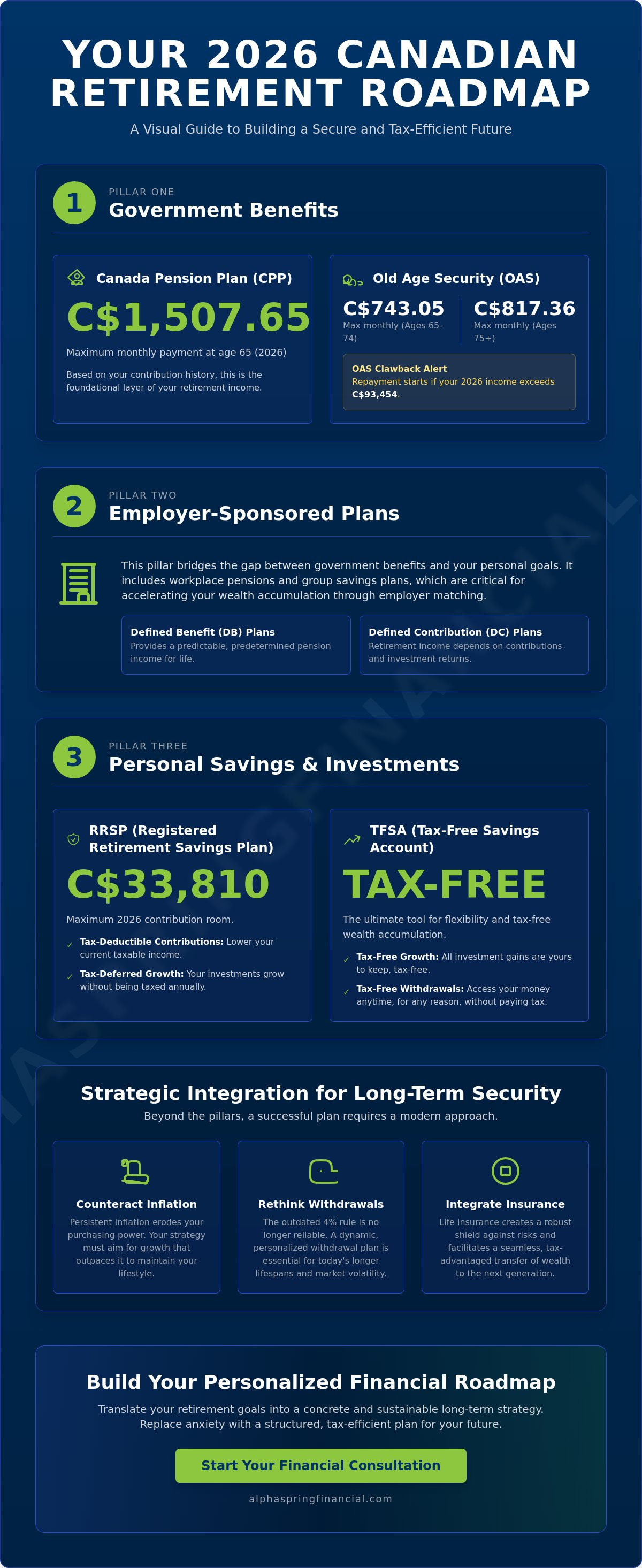
Successful retirement planning Canada relies on a stable, three-dimensional structure. Think of your future income as a tripod; for it to stand firm, each leg must be sturdy and well-positioned. The first pillar consists of government-backed pensions, while the second involves employer-sponsored plans. The third, and often most flexible pillar, is comprised of your personal savings and registered accounts. Many Canadians encounter an "income gap" when they realize their public and employer benefits won't fully fund their desired lifestyle. Identifying this shortfall early allows you to adjust your strategy with precision and foresight.
Public Pensions: The Canada Pension Plan (CPP) and Old Age Security (OAS)
The Canada Pension Plan (CPP) serves as a foundational component for most workers. Your benefit is calculated based on how much and how long you contributed, with the recent CPP enhancement designed to increase the replacement rate of your earnings. For 2026, the maximum monthly payment for those starting at age 65 is C$1,507.65. Complementing this is Old Age Security (OAS), a residence-based benefit. In 2026, the maximum monthly OAS payment for those aged 65 to 74 is C$743.05, increasing to C$817.36 for those 75 and over. You should remain mindful of the 2026 repayment threshold; if your income exceeds C$93,454, you may face an OAS "clawback." Deferring these payments until age 70 can significantly increase your monthly amount, providing a hedge against longevity risk.
Employer Pensions and Group Benefits
Employer-sponsored plans generally fall into two categories: Defined Benefit (DB) and Defined Contribution (DC). A DB plan offers a guaranteed income for life, whereas a DC plan provides a pot of capital based on investment performance. It's vital to recognize that these pensions trigger a "pension adjustment," which reduces your available RRSP contribution room for the following year. As you transition out of the workforce, you'll also need to consider how your group benefits might change. Many retirees choose to replace employer-sponsored health and dental coverage with individual plans to maintain their standard of care. If you have "locked-in" retirement accounts from previous employers, these can often be transferred into a Locked-in Retirement Account (LIRA), ensuring your past hard work continues to grow toward your future goals.
Navigating these overlapping income streams requires a meticulous eye for detail. If you're feeling uncertain about how your various pensions fit together, a dedicated professional can help you forecast your future cash flow with confidence.
- Government Pensions: CPP, OAS, and the Guaranteed Income Supplement (GIS) for low-income seniors.
- Employer Plans: DB and DC pensions, plus any supplemental executive retirement plans.
- Personal Savings: RRSPs, TFSAs, and non-registered investment portfolios.
Strategic Savings Vehicles: RRSPs, TFSAs, and IPPs Explained
Selecting the right vehicle for your capital is a cornerstone of effective retirement planning Canada. While the terminology often feels complex, the underlying objective is simple. You want to maximize your future net worth by minimizing the portion claimed by the tax collector. Understanding the distinction between tax-deferred and tax-free growth is vital for long-term success. A tax-deferred account, such as an RRSP, provides an immediate deduction today but requires you to pay tax on withdrawals later. Conversely, a tax-free account like the TFSA uses after-tax dollars to ensure every cent of growth and future income remains entirely yours. Balancing these tools requires foresight and a deep understanding of your current and future tax brackets.
The Government of Canada retirement planning guide offers a helpful foundation for these registered accounts, yet a truly bespoke strategy goes further. It considers your unique family goals and business structure to determine the most efficient path forward. Precise allocation today prevents unnecessary tax burdens tomorrow.
Maximizing the RRSP vs. TFSA Debate
Your decision to prioritize an RRSP or a TFSA should depend largely on your income trajectory. If you're currently in a high tax bracket, the RRSP is often the superior choice because the immediate tax refund can be reinvested to accelerate growth. For 2026, the RRSP contribution limit has reached C$33,810, offering significant room for high-income earners to reduce their taxable income. These accounts also offer flexibility through the Home Buyers’ Plan and the Lifelong Learning Plan, allowing you to borrow from your future self for major life milestones. However, the TFSA remains a secret weapon for high-net-worth retirees. With a 2026 annual limit of C$7,000, the TFSA allows for tax-free withdrawals that don't trigger OAS clawbacks, providing a level of tactical flexibility that RRSPs cannot match.
The IPP: A Powerful Alternative for Business Owners
For incorporated professionals and business owners, the Individual Pension Plan (IPP) often represents a superior alternative to the standard RRSP. An IPP is essentially a defined-benefit pension plan designed for a single individual. It allows for significantly higher contribution limits than an RRSP, particularly for those over the age of 40. This makes it an exceptional tool for retirement planning Canada when you need to "catch up" on savings or protect a larger portion of your earnings. Beyond personal wealth, the corporate tax advantages are substantial. All contributions made by the corporation are tax-deductible, and the administrative costs are also a business expense. This dual-purpose strategy reduces your corporate tax bill while building a robust, guaranteed income stream for your retirement years.
Beyond the Bank Account: Integrating Insurance and Tax Efficiency
A retirement plan built solely on investment returns is a fragile plan. While accumulating wealth is the primary focus of retirement planning Canada, protecting that wealth from unforeseen life events is equally critical. Insurance acts as the structural reinforcement for your financial house. It ensures that a medical crisis or an untimely passing doesn't dismantle decades of disciplined saving. By integrating strategic insurance solutions, you move from a position of hope to a position of certainty. This holistic approach ensures that your lifestyle is maintained regardless of the challenges life may present.
We view insurance not merely as a cost, but as a sophisticated tool for wealth preservation. When you coordinate your coverage with your investment strategy, you create a robust shield around your assets. This foresight is what separates a standard savings account from a comprehensive financial legacy.
Protecting Your Savings with Living Benefits
Living benefits are financial protections that provide support for your health and well-being during your lifetime. A sudden critical illness diagnosis can be devastating, not just emotionally but financially. Without proper coverage, the costs of private care or specialized treatments can deplete a retirement fund in mere months. You also need to consider how your health and dental insurance needs change once you leave a corporate group plan. Replacing those benefits with an individual policy ensures you maintain your standard of care without dipping into your core capital. Disability insurance also plays a vital role during your earning years; if you cannot work, your ability to fund your future disappears without a replacement income stream.
Tax-Efficient Estate and Succession Planning
The tax implications of the "final return" in Canada are often a shock to surviving family members. Upon death, the Canada Revenue Agency treats most assets as if they were sold at fair market value. This can trigger massive capital gains taxes, particularly on secondary properties like a family cottage or a private business. Professional life insurance provides the liquidity needed to cover these liabilities. This allows your heirs to keep cherished assets rather than being forced to sell them to pay the tax bill. For business owners, this is a cornerstone of succession planning. It allows you to realize the full value of your enterprise while facilitating a tax-efficient transfer to the next generation. If you want to ensure your estate is protected from unnecessary tax erosion, you can book a comprehensive financial analysis to review your current coverage.
Building Your Personalized Canadian Retirement Roadmap
Creating a resilient future requires more than just good intentions. It demands a structured, five-step roadmap that evolves alongside your life. Effective retirement planning Canada begins with a meticulous financial analysis of your current assets and liabilities. You need to understand exactly where you stand before you can decide where you're going. Once your baseline is established, you can determine your desired lifestyle and the estimated annual costs required to maintain it. This isn't just about survival; it's about thriving. Your roadmap must then optimize your tax strategy across all registered and non-registered accounts, ensuring you keep more of what you've earned. Finally, you must secure your plan with the right insurance and estate legalities while partnering with a consultant to monitor and adjust the plan annually. This methodical approach replaces uncertainty with a clear, actionable path toward your goals.
The Importance of Professional Financial Analysis
Forecasting serves as a powerful lens. It allows you to visualize different retirement scenarios and understand how today's decisions impact your future purchasing power. When you engage in professional financial analysis, you're encouraged to look at your whole picture. This includes a careful review of both corporate and personal assets to ensure they're working in harmony. A DIY approach often misses critical tax-saving opportunities or fails to account for the complex interplay between different income streams. Alphaspring Financial Inc. provides the meticulous care required to identify these gaps, ensuring your strategy is as robust as it is efficient.
Taking the First Step Toward Security
The journey toward a stable retirement doesn't have to be overwhelming. It begins with a single, focused conversation. To prepare for your first meeting, you should gather your recent investment statements, tax returns, and a list of your long-term family goals. Having these details ready allows us to provide the bespoke guidance you deserve. Alphaspring Financial Inc. is committed to being your trusted consultant, offering the foresight and stability needed to navigate life's milestones with confidence. You don't have to guess about your future security. Consult with Alphaspring Financial Inc. to begin your retirement roadmap today.
- Analyze: Review all personal and corporate assets.
- Define: Establish your desired lifestyle and budget.
- Optimize: Implement tax-efficient withdrawal strategies.
- Protect: Integrate life and critical illness insurance.
- Review: Schedule annual check-ups to adjust for economic shifts.
Securing Your Legacy with Confidence
You've explored the essential components of a resilient future. Mastering retirement planning Canada is about more than just accumulating capital. It's a strategic coordination of government benefits, tax-sheltered growth, and robust insurance protection. You now understand how to balance RRSPs and TFSAs while leveraging sophisticated tools like Individual Pension Plans to optimize your corporate tax position. This holistic approach ensures your wealth remains protected for the long term.
Since 2017, Alphaspring Financial has focused on providing stable, long-term growth for our clients. We combine deep expertise in IPPs and corporate tax optimization with comprehensive insurance and wealth management solutions. Our goal is to replace uncertainty with a sense of calm and meticulous care. Every detail of your financial journey matters to us, and we're here to act as your trusted guide. You deserve a plan that reflects your unique milestones and family goals.
Secure your future with a personalized retirement strategy from Alphaspring Financial. Your path to financial peace of mind begins with a single, well-informed decision today.
Frequently Asked Questions
How much money do I need to retire comfortably in Canada?
The amount required for a comfortable retirement depends on your unique lifestyle goals and anticipated expenses. A common benchmark suggests you'll need approximately 70% to 80% of your pre-retirement income to maintain your current standard of living. However, effective retirement planning Canada must also account for personal factors like debt levels and travel plans. A bespoke financial analysis can help you determine a precise target based on your specific vision for the future.
What is the best age to start collecting CPP and OAS?
While 65 is the standard age, the optimal time to start benefits depends on your health, longevity, and other income sources. You can start CPP as early as 60, but your monthly payment will decrease by 0.6% for every month you take it before 65. Conversely, deferring these payments until age 70 increases your monthly amount significantly. This provides a guaranteed, inflation-indexed income stream that serves as a hedge against outliving your savings.
Is an RRSP better than a TFSA for retirement savings?
Choosing between an RRSP and a TFSA depends largely on your current tax bracket compared to your expected bracket in retirement. If you're currently in a high tax bracket, the RRSP offers an immediate tax deduction that can be reinvested for growth. If you expect to be in a higher bracket later or value flexibility, the TFSA is often superior. Most successful plans utilize a strategic combination of both to maximize tax efficiency and liquidity.
Can I still contribute to my retirement plan if I am self-employed?
Self-employed individuals have several robust options for retirement planning Canada, including personal RRSPs and TFSAs. Your RRSP contribution room is based on your earned income from the previous year, just like a salaried employee. If you're incorporated, you might also consider an Individual Pension Plan (IPP). This allows for higher contribution limits and provides significant corporate tax advantages, helping you build a more substantial nest egg while reducing your business's tax liability.
What happens to my RRSP when I turn 71?
By December 31 of the year you turn 71, federal regulations require you to close your RRSP. Most Canadians choose to convert their savings into a Registered Retirement Income Fund (RRIF) or purchase an annuity. Once converted to a RRIF, you're required to make minimum annual withdrawals, which are taxed as regular income. Planning this transition early helps you manage the tax impact and ensures a steady flow of income throughout your retirement.
How does inflation affect my Canadian retirement savings?
Inflation acts as a silent tax on your purchasing power, meaning your savings must grow faster than the rising cost of goods and services. If your portfolio doesn't outpace inflation, you may find that your fixed income buys less over time. While CPP and OAS payments are indexed to the Consumer Price Index, your personal investments need a growth-oriented component. We focus on building portfolios that provide the stability you need while protecting against long-term inflationary pressures.
Do I need life insurance if I have a substantial retirement nest egg?
Even with a large nest egg, life insurance remains a vital tool for covering terminal tax liabilities and preserving your estate. Upon death, your non-registered assets and secondary properties may trigger significant capital gains taxes. Life insurance provides the immediate liquidity needed to settle these costs without forcing your heirs to sell cherished assets. It's a strategic way to ensure your full legacy passes to your family rather than being eroded by the final tax return.
What are the tax implications of withdrawing from my retirement accounts?
Tax implications vary significantly based on the type of account you access. Withdrawals from RRSPs and RRIFs are considered taxable income and are added to your other earnings for the year. This can potentially push you into a higher tax bracket or trigger an OAS clawback. In contrast, TFSA withdrawals are entirely tax-free and don't affect your eligibility for government benefits. A coordinated withdrawal strategy is essential to keep your total tax bill as low as possible.