

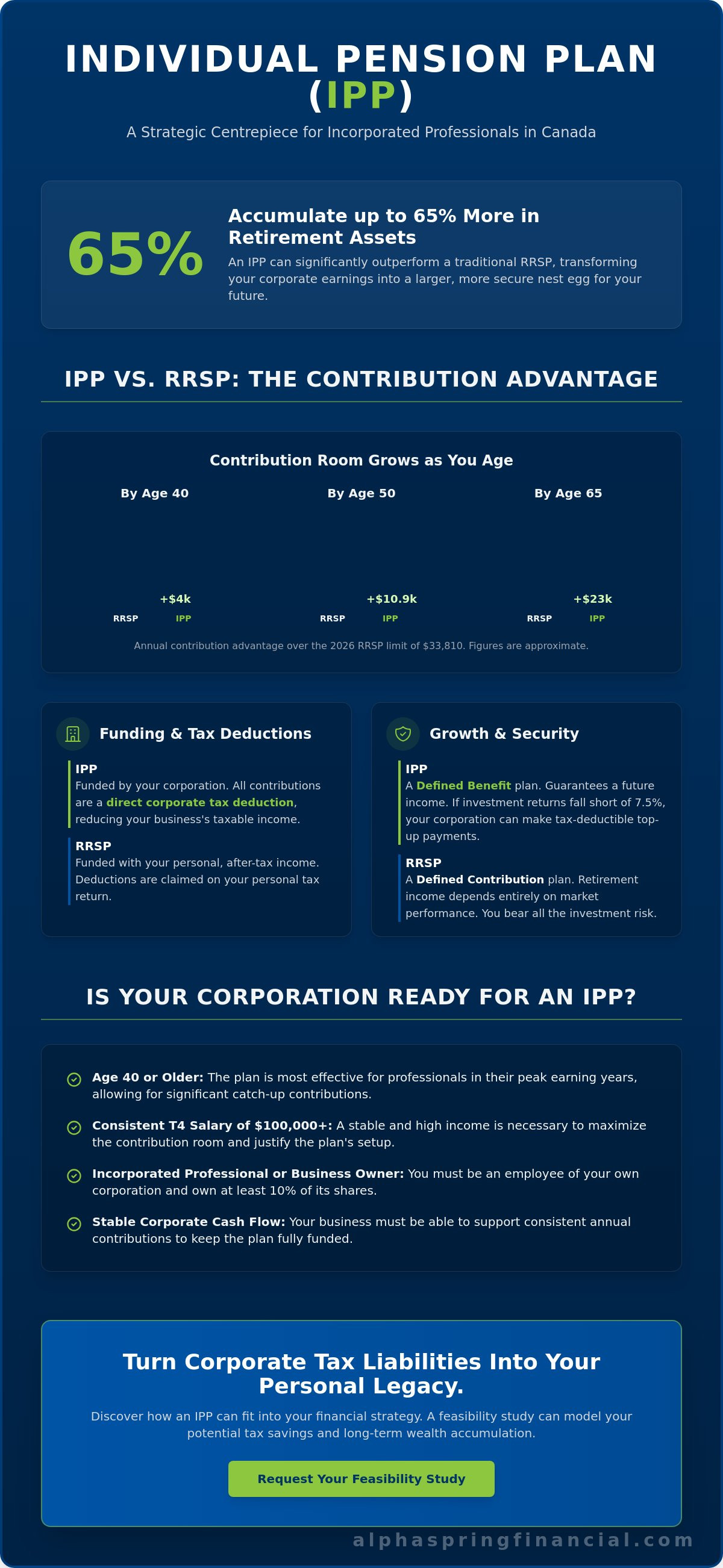
Did you know that an individual pension plan for incorporated professionals can accumulate up to 65% more in assets than a standard RRSP by the time you reach retirement? You've likely felt the frustration of hitting the 2026 RRSP contribution limit of $33,810 while your corporation continues to hold significant retained earnings subject to high tax rates. It feels like you're being penalized for your success; it leaves you uncertain about whether your current strategy will truly provide the long-term stability you've worked so hard to build. We understand that you seek a more strategic way to protect your legacy and realize your financial goals with confidence.
This guide will show you how to leverage an IPP to significantly enhance your retirement savings and reduce your corporate tax burden by turning those liabilities into guaranteed personal wealth. You'll discover how the IPP contribution advantage grows as you age, often exceeding the RRSP limit by $23,040 annually by age 65. We will provide a methodical breakdown of the 2026 regulatory landscape, including the impact of the enhanced CPP, to help you decide if this tailored solution is the right path for your future security.
Key Takeaways
- Understand how an individual pension plan for incorporated professionals acts as a powerful tool to secure your future while reducing immediate corporate tax liabilities.
- Identify the specific T4 salary requirements and age milestones that signal when it's time for your corporation to move beyond the limitations of an RRSP.
- Discover the strategic process for conducting a feasibility study to model your potential tax savings and long-term wealth accumulation accurately.
- Realize how to integrate your pension plan with broader corporate risk management and business succession goals to protect your family's legacy.
What is an Individual Pension Plan (IPP) for Incorporated Professionals?
An individual pension plan for incorporated professionals is a CRA-registered, employer-sponsored defined benefit pension plan designed specifically for business owners and high-earning professionals. Unlike a standard RRSP where you simply save what you can, an IPP is built on a promise of future income. It requires you to be an employee of your own corporation and receive T4 income, effectively making your business the plan sponsor. To understand the foundational rules and regulations, you can read more about What is an Individual Pension Plan (IPP)?. This structure provides a level of foresight and security that discretionary savings accounts cannot match. It transforms your corporation from a simple wealth-generating entity into a robust provider of your long-term security.
To better understand how this structure benefits your long-term security, watch this helpful video:
The Mechanics of a Defined Benefit Structure
The core of this plan is a specific formula that calculates your future retirement income based on your years of service and your T4 earnings. It's a "defined benefit" model, which means the eventual payout is guaranteed rather than being left to the whims of market performance alone. Your corporation acts as the funder; it makes contributions that are calculated by an actuary to ensure the plan remains fully funded. This approach offers significantly more stability than a "defined contribution" model like an RRSP. The formula essentially works backward from your desired retirement age to determine exactly how much capital needs to be set aside today. This removes the guesswork from your financial planning. If investment returns fall short of the required 7.5% annual growth rate set by the CRA, your corporation can make additional tax-deductible contributions to top up the plan. This creates a safety net that protects your standard of living in retirement.
Who Qualifies as a Candidate?
Not every business owner needs an individual pension plan for incorporated professionals, but for those who qualify, the advantages are substantial. Generally, you should own at least 10% of your company's shares to set up this type of plan. It's most effective for professionals who are 40 years of age or older and consistently earn a T4 salary of $100,000 or more. Professionals such as doctors, lawyers, and engineers often find this model fits their career trajectory perfectly. As your earnings peak in your 40s and 50s, the IPP allows you to catch up on retirement savings with much higher limits than an RRSP provides. Because the plan requires regular funding, your corporation needs stable, predictable cash flow to support the annual contributions and the initial setup costs. For those meeting these criteria, the IPP becomes a sophisticated tool for strategic growth and personal protection.
Strategic Tax Advantages: IPP vs. RRSP for Professionals
The transition from a standard RRSP to an individual pension plan for incorporated professionals marks a shift from simple saving to sophisticated wealth engineering. For 2026, the RRSP contribution limit is capped at $33,810. While this is a helpful starting point, it often falls short for high-earning professionals who wish to shelter more of their income. An IPP allows for significantly higher contribution room that scales as you age. By the time you reach age 50, the IPP contribution advantage can be approximately $10,880 more than an RRSP. By age 65, this gap widens to roughly $23,040 annually. This increased capacity allows you to build a retirement fund that can accumulate up to 65% more in assets than a traditional RRSP over the same period.
Every dollar your corporation contributes to the plan is a direct corporate tax deduction. This reduces your business's taxable income, effectively lowering your corporate tax bill while simultaneously building personal wealth. Unlike RRSPs, which are funded with personal after-tax income (later refunded), the IPP is funded directly by the employer. To understand how these contributions interact with your existing limits, the Canada Revenue Agency provides a detailed guide on Strategic Tax Advantages: IPP vs. RRSP and pension adjustments. Beyond the contributions themselves, all actuarial and administrative fees are also tax-deductible to the corporation, ensuring that the cost of maintaining your security is managed efficiently.
Maximizing Your Contribution Room
The limit for an individual pension plan for incorporated professionals is not static. It increases every year as you get closer to retirement. This age-based escalation is a powerful tool for those who may have focused on business growth in their early years and now need to accelerate their savings. When combined with professional corporate tax services in Canada, you can ensure that every contribution is timed perfectly to offset your highest-earning years. This rhythmic increase in room provides a predictable path toward a stable retirement, allowing compounding to work on much larger principal amounts than a standard RRSP would permit.
The Power of Past Service Contributions
One of the most compelling features of an IPP is the ability to recognize "past service." If you have been incorporated for several years but only recently established your plan, you can make a large, one-time contribution to cover those previous years. This catch-up provision can result in a massive initial tax deduction for your corporation. It's an ideal strategy for businesses with a surplus of retained earnings that would otherwise be subject to high tax rates. Integrating this catch-up into a broader retirement planning Canada framework ensures that your transition from active professional to retiree is seamless and well-funded. If you're unsure how these past years might impact your current tax position, a detailed financial analysis and forecasting session can provide the clarity you need to move forward with confidence.
Suitability Checklist: Is Your Corporation Ready for an IPP?
Determining if your business is ready for an individual pension plan for incorporated professionals requires a methodical look at your current compensation and long-term goals. While the tax advantages are compelling, this vehicle is most effective for a specific corporate profile. We typically recommend this strategy for professionals aged 40 or older. This is because the CRA’s contribution formulas become significantly more generous as you approach retirement. To maximize your benefits in 2026, an annual T4 salary of $196,611 is required. If your income is consistently above $100,000, the tax-sheltered growth often outweighs the administrative costs.
Stability is the cornerstone of a successful plan. You must evaluate your corporation's long-term cash flow with a sense of realism. It is a commitment. Unlike a TFSA or a standard corporate investment account, an IPP is a formal promise of future funding. It offers superior creditor protection and a guaranteed income stream, but it rewards those who can maintain steady contributions through various market cycles. Your business must possess the liquid strength to support these contributions over the next decade or two.
The Salary vs. Dividend Dilemma
Many incorporated professionals prefer receiving dividends to minimize personal income tax and avoid CPP contributions. However, dividends do not create "earned income" for pension purposes. To utilize an individual pension plan for incorporated professionals, you must shift toward a salary-based compensation model. This transition might increase your personal tax bracket, but the massive corporate deduction and the resulting pension credits usually provide a higher net benefit. You're essentially choosing to pay a bit more personally now to secure a significantly larger, tax-protected wealth pool for the future. If you want to see how this shift affects your bottom line, a detailed financial analysis and forecasting session can provide the necessary clarity.
Administrative and Actuarial Considerations
An IPP is a sophisticated legal entity that requires diligent maintenance. You must conduct an actuarial valuation every three years to ensure the plan remains properly funded according to CRA standards. These valuations are essential for maintaining the plan's registered status and ensuring your future benefits are secure. While there are costs associated with setup and annual administration, these expenses are fully deductible for your corporation. Meticulous oversight ensures your plan remains compliant with evolving tax laws while you focus on your professional practice. Professional guidance is a necessity to ensure every regulatory filing is handled with care and precision.
The Implementation Process: Setting Up Your Pension Plan
Setting up an individual pension plan for incorporated professionals is a structured journey that transforms your corporate wealth into a personal legacy. It is a deliberate transition from the generic limits of an RRSP to the sophisticated security of a bespoke defined benefit plan. This journey begins not with paperwork, but with a deep analysis of your corporate history and future aspirations. By following a methodical implementation process, you can move from uncertainty to a position of quiet confidence regarding your retirement income. Order creates confidence; every detail is handled with meticulous care to ensure the final structure is both compliant and highly effective.
The process involves a comprehensive review of your T4 earnings and corporate financial health. This data allows for the creation of a tailored plan design that aligns with your specific life milestones. Once the design is finalized, the legal framework is established through a formal plan text and trust agreement. This document serves as the constitution of your pension, outlining the rules for contributions and eventual benefit payments. After corporate approval, the plan is submitted for registration with the Canada Revenue Agency and the relevant provincial pension authorities. This formal recognition is what secures the tax-deductibility of your contributions.
Phase 1: Feasibility and Design
Before committing to the plan, you must understand exactly how it will perform within your unique corporate structure. This phase focuses on gathering historical T4 data to identify missed contribution opportunities from previous years of service. A specialized consultant will model various scenarios to determine the optimal contribution levels that balance corporate cash flow with your retirement goals. This comparison allows you to see the tangible benefits of the IPP over your current discretionary savings strategy. It ensures that the plan you build today is the one that will support your family decades from now. Precise modeling removes the guesswork from your long-term security.
Phase 2: Registration and Compliance
Once the design is validated, the focus shifts to formalizing the plan's legal status. You must submit a formal application for registration to the CRA to secure the plan's tax-exempt status. Simultaneously, a pension trust is established to hold and invest the plan assets. This ensures they are protected and managed according to the plan's objectives. This stage also involves setting up a steady rhythm for ongoing reporting and the triennial actuarial valuations required by law. Maintaining registered status is vital for long-term compliance and peace of mind. If you are ready to begin this transition, our financial consulting services can guide you through each phase with precision.
The final step is funding. Your corporation will make the initial contributions, which often include a significant payment for past service. This immediate injection of capital jumpstarts your retirement fund while providing the substantial tax relief your business requires. This methodical setup ensures that your pension is built on a foundation of traditional reliability and proven expertise.
Integrating Your IPP into a Holistic Business Strategy
An individual pension plan for incorporated professionals is most effective when it serves as a cornerstone of a broader corporate architecture. It is not merely a destination for surplus cash; it is a strategic tool that must be synchronized with your overall business objectives. This unified approach ensures that your retirement security is protected against the unforeseen while optimizing your tax position. By viewing the IPP through the lens of a holistic strategy, you move from managing an account to building a lasting legacy. Every component of your financial life should work in harmony to support your long-term vision.
Succession planning is another area where the IPP offers a distinct advantage. For family-owned businesses, an IPP can be used to facilitate an intergenerational transfer of wealth. Family members who are employees of the corporation can often be added to the plan, allowing for a tax-efficient shift of assets. This strategy avoids the heavy tax burden often associated with withdrawing large sums of capital from a corporation during a business sale or transition. Professional accounting and tax oversight are essential here to track pension liabilities and ensure the plan remains a benefit rather than a burden during a transition.
Risk Management and Living Benefits
Protecting the corporation’s ability to fund the plan is a vital consideration that many professionals overlook. If a health crisis or disability prevents you from working, the cash flow required to maintain your pension contributions could be at risk. Integrating disability insurance into your corporate plan ensures that your funding continues even when you cannot be at the helm. There is also a powerful synergy between pension planning and life insurance Canada for estate protection. While the IPP builds wealth during your lifetime, insurance provides the immediate liquidity needed to manage taxes upon death. This ensures that your wealth strategy accounts for every health milestone with foresight and calm.
The Alphaspring Advantage: A Unified Perspective
We believe that the most successful individual pension plan for incorporated professionals is one that is managed with a unified perspective. We bridge the gap between corporate tax efficiency and personal wealth by coordinating your corporate tax, insurance, and pension needs under one roof. Having a single point of contact for these complex requirements removes the friction often found when working with disconnected advisors. This methodical coordination allows us to spot opportunities that others might miss, such as timing past-service contributions to coincide with high-income years. Moving forward with a plan that prioritizes your peace of mind ensures that your future is handled with the meticulous care it deserves.
Securing Your Financial Legacy with Confidence
Transitioning to an individual pension plan for incorporated professionals is a strategic shift that replaces the limitations of discretionary savings with the stability of a guaranteed benefit. You have discovered how this vehicle optimizes your corporate tax position while providing significantly higher contribution limits than a standard RRSP. By integrating this plan with your broader risk management and estate goals, you ensure that your years of hard work translate into a protected future for your family and your business.
Since 2017, Alphaspring has focused on the integrated financial health of Canadian professionals with a sense of meticulous care. Our expertise spans accounting, corporate tax, and insurance; this allows us to provide a unified perspective that bridges the gap between your business success and personal security. We offer national service coverage to help you realize a retirement strategy that is as unique as your professional practice. Book a consultation with our IPP specialists to secure your legacy and take the first step toward a more stable tomorrow. Your future deserves the foresight of a trusted guide who understands your milestones.
Frequently Asked Questions
What happens to my Individual Pension Plan if I sell my business?
You have several options to protect your assets if you decide to sell your corporation. You can transfer the plan to the new owner, wind it up and transfer the funds to a Locked-In Retirement Account (LIRA), or merge it with a new company's plan. This flexibility ensures that the wealth you've built remains secure and continues to grow tax-deferred regardless of your business's ownership status.
Can I contribute to both an RRSP and an IPP at the same time?
You can contribute to both, but your RRSP room will be significantly reduced by a pension adjustment. The CRA formula ensures you don't receive double the tax-sheltered room. Most people find that the individual pension plan for incorporated professionals offers much higher limits, often making the RRSP a secondary tool used only for the small amount of remaining room permitted under the rules.
Is an IPP creditor-protected in Canada?
Yes, assets held within an IPP generally enjoy robust creditor protection under provincial and federal pension legislation. This is a significant advantage for professionals who want to shield their retirement capital from business risks or legal claims. While RRSPs offer some protection, the statutory shielding provided to registered pension plans is typically more comprehensive across most Canadian provinces.
What is the minimum salary I need to justify an Individual Pension Plan?
You typically need a T4 salary of at least $100,000 to make the setup and actuarial costs worthwhile. To reach the maximum contribution limit in 2026, an income of $196,611 is required. If your salary is below these levels, the tax savings might not outweigh the administrative fees. It's a sophisticated tool designed for those with high, stable earnings.
What happens if the investments in my IPP perform poorly?
If your plan's investment returns fall below the mandated 7.5% annual rate, your corporation can make additional tax-deductible contributions to cover the shortfall. This is a unique feature of the defined benefit model. It allows you to use corporate funds to repair investment losses while simultaneously reducing your company's taxable income. It ensures your retirement goals stay on track despite market volatility.
Can my spouse be included in my Individual Pension Plan?
Your spouse can be included in the plan if they are a T4 employee of your corporation. Creating a family individual pension plan for incorporated professionals is an excellent way to split income and maximize corporate tax deductions. It doubles the plan's contribution room and secures a stable retirement income for both partners. This approach also simplifies your family's long-term legacy and succession planning.
How are IPP withdrawals taxed once I retire?
Withdrawals from your pension are taxed as regular income in the year you receive them. This is the same treatment applied to RRSP or RRIF payments. Because you'll likely be in a lower tax bracket during retirement, the overall tax burden is often reduced. You can also utilize pension income splitting with your spouse to further optimize your family's net tax position.
What are the terminal funding options for an IPP?
Terminal funding allows your corporation to make a final, large tax-deductible contribution at the time of your retirement. This payment is designed to fully fund the promised pension benefit, accounting for factors like inflation indexing or early retirement. It serves as a powerful last-minute strategy to move corporate surplus into your personal retirement fund. It provides a significant final tax relief for the business.